Thank you for wanting to learn more about us. Download the PDF
here.
To stay updated with our latest content, please follow us on LinkedIn.
Oops! Something went wrong while submitting the form.
Oil & Gas

Scaling carbon capture, utilization and storage with unified digital operations

Reduced downtime
across CCUS operations
Improved audit
readiness and safety
Lowered monitoring costs
through automation
tech stack
Angular, Material UI, Plotly, Leaflet, Node.js, Express, TypeScript, RabbitMQ, Dapr, Microservices, Redis, PostgreSQL, Azure Blob Storage, Databricks, Cucumber, Selenium, JMeter, Postman, Python & Java automation scripts, Jenkins, GitHub, Kubernetes, Docker, Azure, Azure CDN, Azure Load Balancer, Blackduck, Checkmarx, Prisma, AVScan, DAST
AT A GLANCE

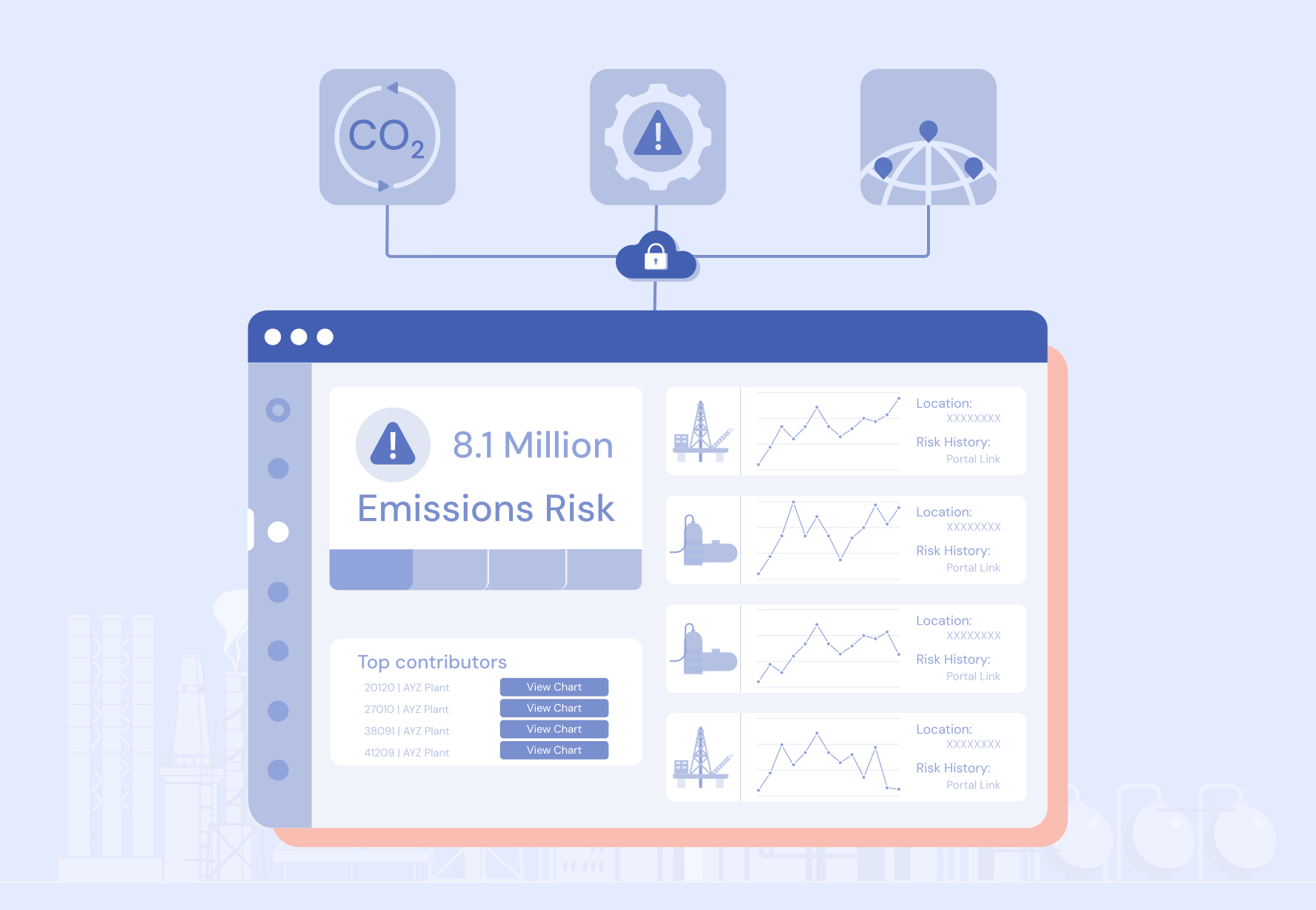
A leading energy services provider partnered with Zemoso Labs to tackle fragmented data systems across its carbon capture, utilization, and storage (CCUS) program, where disjointed monitoring tools and manual compliance workflows slowed responses to operational risks. Zemoso built a unified digital platform that aggregates sensor data from wells, fields, and plants into a single, real-time view, embedding risk management and alert intelligence so engineers can act fast on live field conditions. The result: reduced downtime, improved safety, lower monitoring costs, and stronger audit readiness, directly supporting the client's net-zero targets and CCUS expansion.

CORE CHALLENGEs

Scaling carbon capture, utilization and storage (CCUS) exposes recurring problems: subsurface, surface, and plant-level systems operating in silos, manual or inconsistent monitoring, rising compliance complexity, and delayed anomaly detection that increases safety and financial risk. The client's CCUS teams were managing isolated data streams, raw CSV exports from wells and plants requiring manual handling before analysis, with no real-time view across assets. The mandate was to build one system connecting subsurface, surface, and plant data with proactive, compliance-linked risk and alert management on a cloud-native architecture ready for global scale-up.

the engineering approach

Zemoso engineered a unified digital backbone for CCUS-secure, modular, and capable of real-time processing across heterogeneous data sources. The key breakthrough was linking subsurface-to-surface telemetry with a risk-aware alerting layer, ensuring every anomaly carried both context and traceability.

  • Unified data and visibility: A central platform powered by Databricks ingests and aggregates raw CSV streams-pressure, temperature, flow, acoustic, and microseismic data-from wells, fields, and plants. The front-end stack (Angular, Plotly, Leaflet) delivers world-map visualizations, KPI cards, and asset-level dashboards. Operators and executives share the same single source of truth, removing delays caused by disconnected tools.
  • Proactive risk detection and management: A structured risk-management framework was embedded in the system. Users can define risks, assign severity, and link mitigations directly to alerts. Each event moves through a defined chain, hazard → alert → control, so teams see not just what happened, but why and what to do next. This shifted alerting from noise generation to informed decision support.
  • Compliance-first framework: Every workflow was designed to satisfy emissions reporting and audit demands. Alerts tie to thresholds such as CO₂ injection pressure or flow anomalies, and exports produce audit-ready CSVs. Role-based access control governs visibility and permissions, making compliance a native outcome rather than a parallel process.

Scalable Cloud-native Architecture: Built on 18 microservices orchestrated through Kubernetes, the backend stack, NodeJS, Express, TypeScript, handles distributed workloads efficiently. Redis caching supports high-frequency queries, Azure Blob Storage manages large sensor datasets, and RabbitMQ with Dapr ensures reliable event messaging. CI/CD pipelines via Jenkins and GitHub enable frequent, secure deployments without downtime.

Advanced Security and Reliability: A layered security model protects sensitive operational data-

  1. Static and dynamic code testing (Checkmarx, DAST)
  2. Cloud monitoring (Prisma) and vulnerability scans (AVScan, Black Duck)
  3. Encrypted Docker images and hardened transmission protocols

Together, these safeguards ensure both cyber and operational integrity for regulated CCUS environments.

bottom line

The collaboration turned CCUS monitoring from a network of disconnected tools into a single, auditable digital system that scales. By fusing data architecture with operational safety and compliance, the platform turned carbon management from manual oversight into automated assurance, giving the client a digital foundation built for regulatory resilience and scalable decarbonization.

Related resources

Got an idea?

Together, we’ll build it into a great product

DesignDesign
Zemoso Technologies
ZemosoTechnologies ZemosoTechnologies

©2025 Zemoso Technologies. All rights reserved.