

In 1900, American factory owners began replacing central steam engines with electric motors. The new technology was cleaner, faster, and dramatically cheaper to run. Yet for nearly three decades, industrial productivity barely budged.
As economic historian Paul David observed in his study of the dynamo paradox, the problem wasn't the engine, it was the layout. Manufacturers had simply bolted electric motors onto factories that were still organized around central drive shafts, belts, and overhead pulleys. Productivity exploded only after they fundamentally redesigned the factory floor, placing independent motors on individual machines and reorganizing work around the new technology.
Today, the software industry is living through its own version of the dynamo paradox—compressed from decades into months.
Across engineering organizations, generative AI writes code at remarkable speed. Features ship faster. Development cycles shrink. Dashboards report impressive productivity gains.
Yet beneath those metrics, leaders are confronting a quieter problem. Engineers are deploying systems they struggle to explain, accepting AI-generated solutions without fully understanding the underlying trade-offs, and finding themselves ill-equipped to diagnose failures when production inevitably behaves in unexpected ways.
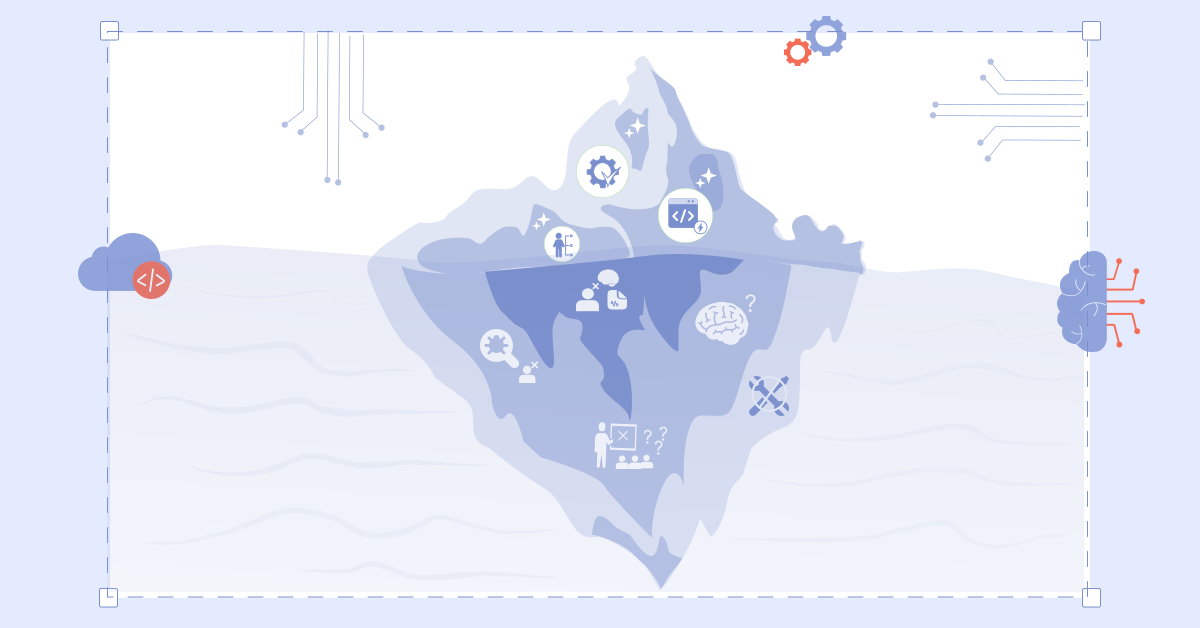
The industry has a name for this phenomenon: cognitive debt—the accumulated cost of knowledge that was never acquired because the thinking was delegated.
The instinctive response has been predictable. Organizations are introducing stricter code reviews, mandatory documentation, AI governance policies, and requirements for developers to explain AI-generated code before it reaches production.
These interventions are well intentioned. They are also aimed at the wrong problem.
You cannot recover understanding at the end of a process if it was never built at the beginning.
The deficit begins upstream
The assumption behind most governance initiatives is straightforward: AI-generated code becomes risky because humans are not reviewing it carefully enough.
Recent research suggests something different.
In a randomized controlled trial, researchers from Anthropic studied software engineers working on an unfamiliar programming task with and without AI assistance. Engineers using AI scored significantly lower on a subsequent comprehension assessment, averaging 17% lower than peers who completed the task manually.
But the most important finding wasn't the average score.
The gap depended almost entirely on how engineers used AI.
The weakest performers treated the model as a substitute for reasoning, accepting solutions with minimal interrogation and gradually surrendering the cognitive effort required to build understanding. The strongest performers used the same tools very differently. They challenged assumptions, asked follow-up questions, explored alternatives, and used AI to strengthen their mental models rather than replace them.
The technology wasn't determining the outcome.
The behavior was.
This distinction matters because it reveals why many organizational responses fall short.
Code reviews can evaluate the quality of an artifact. They cannot reconstruct the learning that never happened while that artifact was being created. Asking an engineer to explain AI-generated code after the fact is like asking someone to remember a conversation they never had.
Cognitive debt is not created during review.
It is created the moment someone chooses to delegate understanding instead of work.
The wrong question
Much of the conversation around AI adoption asks the same question:
Not every cognitive task creates equal value.
Generating boilerplate, writing repetitive test cases, or scaffolding common patterns are excellent candidates for delegation. They consume time without necessarily deepening expertise.
Architectural trade-offs, debugging unfamiliar systems, reasoning through production incidents, evaluating security implications, and understanding why a solution works are different. These are the moments where organizations build capability—not just software.
When those moments are delegated, knowledge doesn't disappear.
It simply never enters the organization.
The two paths of AI adoption
As AI becomes embedded in engineering workflows, organizations are beginning to follow one of two paths.
The first optimizes individual productivity.
Developers use AI as a high-speed personal assistant. Success is measured through velocity—features delivered, pull requests merged, tickets closed. Engineers independently decide what to delegate and what to understand. Every individual becomes faster.
The second optimizes organizational capability.
Here, AI is still pervasive, but the organization develops shared norms around delegation. Teams collectively understand which tasks can safely be outsourced and which forms of reasoning remain fundamentally human. Success is measured not only by output, but by architectural judgment, operational resilience, and the team's ability to understand and evolve the systems it builds.
The distinction mirrors the dynamo paradox.
Installing electric motors inside a steam-powered factory made individual machines faster, but it did little to improve the factory itself. Real productivity arrived only after manufacturers redesigned the entire production system around the new technology.
Many engineering organizations are making the same mistake today.
They are optimizing developers without redesigning how engineering knowledge is created, shared, and retained.
The result is a paradox.
Code output rises.
Organizational intelligence does not.
Cognitive debt is a cultural problem.
This is why cognitive debt cannot be solved with another governance checklist.
It is not fundamentally a software engineering problem.
It is an organizational behavior problem.
Every engineering culture teaches people what excellence looks like.
Some cultures celebrate shipping speed above everything else. Others quietly reward whoever can demonstrate the most AI usage or produce the highest volume of code. None of these metrics distinguish between work that was accelerated and understanding that was abandoned.
Engineers respond rationally to those incentives.
If promotions reward throughput, people will maximize throughput.
If leadership praises whoever delivers the most code in the shortest time, delegation becomes the default response—not because engineers lack curiosity, but because the organization has defined speed as success.
Changing that trajectory requires more than policy.
It requires leaders to establish a different operating philosophy.
Instead of asking, "How much work can AI do for us?", leaders need to ask, "What knowledge do we expect every engineer to own?"
That philosophy becomes visible in everyday decisions.
Senior engineers challenge AI-generated architectural recommendations—not because the output is necessarily wrong, but because explaining why a different approach is better teaches everyone else what good judgment looks like.
Architecture reviews become discussions about trade-offs rather than approvals of finished solutions.
Incident retrospectives focus on understanding rather than blame.
Performance conversations recognize engineers who strengthen the team's collective capability, not just those who maximize personal velocity.
Culture cascades through observation long before it spreads through documentation.
Developers learn what matters by watching what leaders consistently reward.
Redesigning the factory
Like financial debt, cognitive debt is not inherently harmful.
Borrowing against future capability can be a rational decision when speed matters. Every organization will occasionally choose to let AI handle work that humans could have done themselves.
The problem begins when organizations accumulate that debt without recognizing they have borrowed anything at all.
The software industry does not have an AI capability problem.
It has an organizational design problem.
Electric motors transformed manufacturing only after factories were redesigned around them. AI will transform software engineering only when organizations redesign themselves around a more important question than productivity:
What should our engineers never hand off entirely?
The companies that answer that question well won't be the ones that use the most AI.
They will be the ones that understand, with intention, what should never be delegated.