Others

Platform engineering 2.0: solving the adoption crisis and the AI surge

This is some text inside of a div block.
tech stack
This is some text inside of a div block.
Accelerating transactional integrity cover image
AT A GLANCE

By 2026, 80% of software engineering organizations would establish dedicated platform teams. While organizational adoption hit record highs, the industry faces an execution crisis: 89% of teams reported running an internal developer platform, yet those platforms frequently reduced software delivery throughput and stability rather than improving it, especially when imposed across the full lifecycle instead of earning voluntary use.

Meanwhile, generative AI coding assistants have changed how software gets delivered. Engineering teams draft code at unprecedented speeds, shifting the operational bottleneck away from writing code and directly into testing, compliance validation, and deployment pipelines.

For technology leaders, the question is no longer what an Internal Developer Platform (IDP) is. The work now is fixing adoption, eliminating cognitive overload, and scaling delivery infrastructure for AI-generated workloads.

The 2026 reality check: why 80% of companies have platforms, but half are failing

The primary failure mode in platform engineering is building an internal system around top-down infrastructure assumptions rather than developer user research. When developers are handed a platform designed without their daily friction in mind, they simply find workarounds.

Platforms rarely fail because of software bugs. They fail on operational and product management ground: unclear ownership, no adoption metrics, and roadmaps built without developer input.
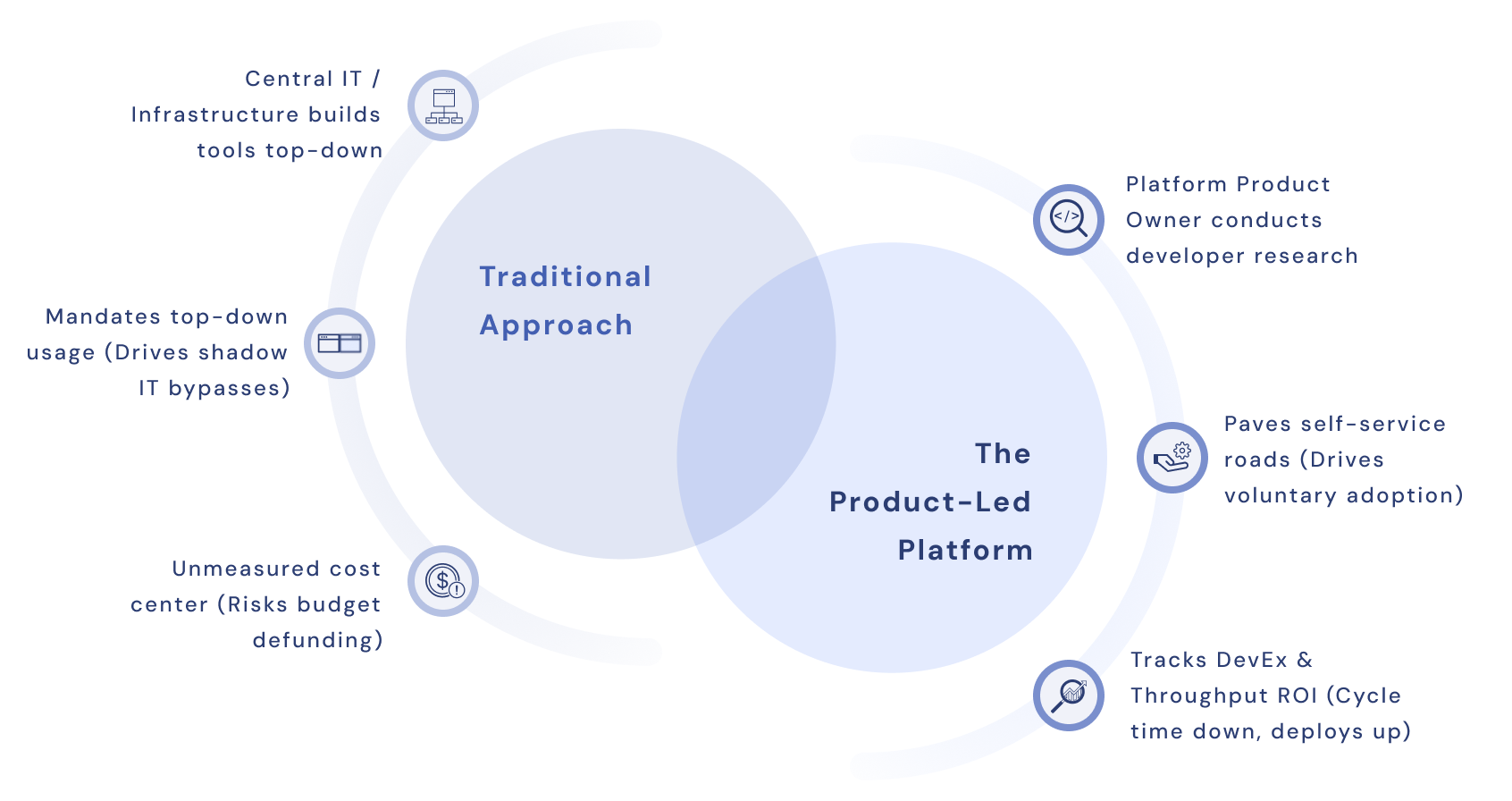
The transition from "building a platform" to "driving developer adoption

Building an Internal Developer Platform (IDP) is only half the battle; driving voluntary adoption is where most enterprise initiatives stall.

  • Moving away from forced mandates: Top-down mandates to use a platform fail because developers will always find shadow IT workarounds if the platform is slower than their custom scripts.
  • Focusing on developer experience (DevEx): Platform teams must shift their primary success metric from system uptime to Developer NPS (eNPS), cycle time reduction, and voluntary usage rates.

Why DIY developer portals fail without product management

A portal placed over manual ticketing queues keeps every existing IT handoff in place. Developers wait exactly as long as before, now behind a cleaner interface.

Infrastructure teams frequently treat portals as static engineering projects rather than living internal products. Without dedicated product management tracking Developer Experience (DevEx) metrics, internal portals drift away from actual engineering workflows, turning into expensive, underutilized directory sites.

From "shifting left" to "shifting down"

For years, software engineering preached "Shifting Left," which asked engineers to take direct ownership of infrastructure provisioning, container security, CI/CD pipelines, and cloud cost management.

This shift created severe developer cognitive overload. Engineers spent significant working hours managing Kubernetes configurations, IAM roles, and deployment scripts rather than writing core business logic.

Why forcing developers to learn Kubernetes and security policies failed

Expecting every software developer to become an expert in Kubernetes YAML manifests, cloud IAM policies, Terraform scripts, and security scanning tools burned engineering teams out. Instead of making teams faster, it forced engineers to context-switch away from feature development to troubleshoot complex infrastructure stack failures.

How Zemoso builds platforms that embed compliance, FinOps, and security implicitly

Platform engineering corrects this balance by Shifting Down. Instead of requiring developers to become cloud infrastructure experts, Zemoso designs platforms that absorb those responsibilities into the underlying delivery layer:

  • Implicit security guardrails: Vulnerability scanning, secrets management, and IAM roles execute automatically in the background whenever code is committed.
  • Automated FinOps controls: Cloud resource quotas, automated environment tear-downs, and token budgets are hardcoded into developer templates to prevent cloud spend leakage.
  • Continuous compliance capture: Audit logs and compliance proof are recorded automatically by the platform during normal execution, eliminating pre-release audit fire drills.

The AI bottleneck: scaling platforms in the age of AI code generation

Generative AI has multiplied the volume of code entering the pipeline. Teams with high AI adoption merge far more pull requests, but review time, PR size, and downstream queues climb with them, moving the bottleneck from writing code to testing, integration, and deployment.

Modernizing IDPs to handle AI-generated code volume and agentic workflows

As developers and AI agents submit higher volumes of pull requests, legacy CI/CD pipelines collapse under the strain. Modern IDPs must evolve across two core fronts:

  1. AI-powered pipelines: Integrating automated Pull Request (PR) analysis, self-healing integration test suites, and dynamic staging environment creation to validate high-volume code commits without overwhelming human reviewers.
  2. Platforms for AI workloads: Providing self-service access to governed LLM gateways, token budget limits, RBAC-protected API tools, vector database provisioning, and GPU resource allocations for engineering teams shipping AI-native applications.

The "platform as a product" framework

Treating an Internal Developer Platform (IDP) as a static IT project is the fastest way to get defunded. Successful platforms operate as internal SaaS products, where software developers are treated as active customers, adoption is earned through value, and features are prioritized using developer research.

How Zemoso partners with enterprises to transform reactive IT teams into product-led platform teams

Zemoso embeds dedicated platform product leads and architects alongside enterprise engineering organizations, shifting internal operations from a ticket-driven cost center toward a product-led function:

  • Friction research & discovery: Mapping critical user journeys to isolate exact delay points in the current engineering workflow before writing a line of platform code.
  • Self-service golden paths: Paving automated, fully compliant workflows for core engineering tasks (microservice creation, database provisioning, environment setups) that developers choose to use over legacy workarounds.
  • Product-led backlog prioritization: Structuring the platform roadmap based strictly on developer feedback, friction data, and adoption analytics rather than top-down IT assumptions.

Measuring actual ROI: cycle time, eNPS, and time to first commit

29.6% of platform teams do not measure success or ROI at all, and another 24.2% track metrics but cannot tell whether performance has improved over time.

Product-led platform engineering establishes quantitative telemetry from day one:

Partner with Zemoso

Zemoso collaborates with enterprise organizations to design and build innovative solutions while maximizing engineering velocity. Contact us.

CORE CHALLENGEs

Heading 1

Heading 2

Heading 3

Heading 4

Heading 5
Heading 6

Lorem ipsum dolor sit amet, consectetur adipiscing elit, sed do eiusmod tempor incididunt ut labore et dolore magna aliqua. Ut enim ad minim veniam, quis nostrud exercitation ullamco laboris nisi ut aliquip ex ea commodo consequat. Duis aute irure dolor in reprehenderit in voluptate velit esse cillum dolore eu fugiat nulla pariatur.

Block quote

Ordered list

  1. Item 1
  2. Item 2
  3. Item 3

Unordered list

  • Item A
  • Item B
  • Item C

Text link

Bold text

Emphasis

Superscript

Subscript

the engineering approach

Heading 1

Heading 2

Heading 3

Heading 4

Heading 5
Heading 6

Lorem ipsum dolor sit amet, consectetur adipiscing elit, sed do eiusmod tempor incididunt ut labore et dolore magna aliqua. Ut enim ad minim veniam, quis nostrud exercitation ullamco laboris nisi ut aliquip ex ea commodo consequat. Duis aute irure dolor in reprehenderit in voluptate velit esse cillum dolore eu fugiat nulla pariatur.

Block quote

Ordered list

  1. Item 1
  2. Item 2
  3. Item 3

Unordered list

  • Item A
  • Item B
  • Item C

Text link

Bold text

Emphasis

Superscript

Subscript

bottom line

Heading 1

Heading 2

Heading 3

Heading 4

Heading 5
Heading 6

Lorem ipsum dolor sit amet, consectetur adipiscing elit, sed do eiusmod tempor incididunt ut labore et dolore magna aliqua. Ut enim ad minim veniam, quis nostrud exercitation ullamco laboris nisi ut aliquip ex ea commodo consequat. Duis aute irure dolor in reprehenderit in voluptate velit esse cillum dolore eu fugiat nulla pariatur.

Block quote

Ordered list

  1. Item 1
  2. Item 2
  3. Item 3

Unordered list

  • Item A
  • Item B
  • Item C

Text link

Bold text

Emphasis

Superscript

Subscript

What are our clients saying?

Our clients love what we do

skyflow logo
cellino logo
Teknor Apex logo
ZUS logo
stratoes logo
Profile image
Prakash Khot
Co-Founder
company logo
Data Security
Rapid and iterative prototyping is both a science and an art form that requires design thinking, excellent grasp of use cases, and state of the art technologies. It's not easy to build prototypes, and for that reason - frequently- entrepreneurs use external expertise to build them. I have effectively continually done so with our partnership Zemoso Technologies and would work with them again.
Profile image
Ozge Whiting
VP Data & Machine Learning
company logo
Biomanufacturing Tech
I was very impressed with the speed at which Zemoso operated, starting from our first conversational engagement to setting up a team and completing our Design exercise along with a proof of concept to visualize our complex datasets using interactive web technologies. We didn’t hesitate to continue with several development engagements where Zemoso provided a top-notch scrum team to work very closely with our internal teams, always delivering with the mindset of maximum satisfaction. Their understanding of the complexities of an evolving solution and ability to pivot with acute urgency makes them a solid software development partner for any start-up and business out there.
Profile image
Fabricio Arteaga
Director of Strategic Relationships and Sustainability
company logo
Global Polymer Innovator
Zemoso's expertise proved fundamental in helping us quickly validate our concept and discover broader market demand than initially anticipated. Their collaborative approach to rapid prototyping and technical assessment not only transformed our concept into a robust, scalable solution but also strengthened TekVentures' own capabilities in venture building.
Profile image
Ada Glover
Co-Founder & Chief Product Officer
company logo
Healthcare and Life Sciences
The Zemoso team has been a compelling partner through build and deployment. Initially, the Zemoso team co-facilitated a Design Sprint that resulted in a compelling product that was used for user research and recruitment of early customers. Zemoso then partnered closely with Zus product and engineering counterparts to design, build, test and deploy capabilities on an aggressive timeline. The Zemoso team was collaborative, proactive, and brought a diverse set of capabilities to the table. They continue to be a trusted partner.
Profile image
Alok Gupta
SVP Engineering
company logo
Life Science Discovery
The Zemoso team has been super helpful, they have taken a lot of load off the existing team, we were able to churn out a lot more features because of this partnership. Our product team has been able to focus a lot on new customer acquisition and product line diversification. Zemoso development team is an integral part of our team, an extended arm to rely upon.

Got an idea?

Together, we’ll build it into a great product

DesignDesign
Zemoso Technologies
ZemosoTechnologies ZemosoTechnologies

©2026 Zemoso Technologies. All rights reserved.

Metric category|Traditional infrastructure model|Product-led platform model|Business impact Time to first commit|Weeks spent configuring local environments & permissions.|Under 2 days via automated self-service scaffolding.|Accelerated new engineer onboarding and time-to-value. Provisioning overhead|Multi-day ticket queue for databases & environments.|Minutes via self-service APIs.|Eliminates cross-team waiting friction. Delivery cycle time|Coordinated, manual deployment schedules with high friction.|Measurable cycle time reduction with higher deploy frequency.|Faster release cadence and market responsiveness. Developer sentiment (eNPS)|Frustration over manual gates and complex YAML setups.|High internal adoption & sentiment via seamless DevEx.|Improved engineer retention and lower burnout.