Services Rendered

Product Design

Product Engineering
.svg)
Software Development
MagicBI is an AI-native autonomous analytics and business intelligence platform designed to eliminate the analytics bottleneck that separates raw data from business-ready answers, helping organizations move from business questions and data toward decision-ready insights and narratives.
In enterprise BI, data accuracy and governance are non-negotiable—if an executive query generates an incorrect SQL join or misinterprets a metric definition, trust in the platform collapses.
To deliver this platform without compromising velocity, the engineering team adopted an AI-native software delivery lifecycle. By embedding Anthropic’s Claude Code CLI and Model Context Protocol (MCP) across product specification, design implementation, development, testing, and security workflows, the team accelerated execution while maintaining strict architectural standards.
Zemoso partnered with MagicBI to design and orchestrate these Claude-powered workflows across the build.
Building a modern analytics platform requires balancing two competing demands: giving data and business teams appropriate control over enterprise definitions, context, and governance, while enabling business consumers to interact with analytics using natural language.
Enterprise analytics systems can struggle when translating complex data structures and business definitions into understandable answers. Traditional setups often require manual SQL engineering or rigid reporting templates, creating bottlenecks for business teams while overburdening data teams.
As MagicBI scaled across a sophisticated data and application architecture, several standard developer friction points threatened execution speed:
"We've been working with MagicBI on an AI-native engagement — one that leverages AI deeply both in how we build the product and in the intelligence it delivers. Enterprise data analytics is complex: how you ground data, layer in context, and make sure the output holds up when someone questions it. Claude has been genuinely useful in working through that complexity fast and build this grounds-up product." — Kanchuki Sharma, Head of Product and Design, Zemoso
The team integrated Anthropic’s Claude Code and MCP directly into four core operational workstreams:
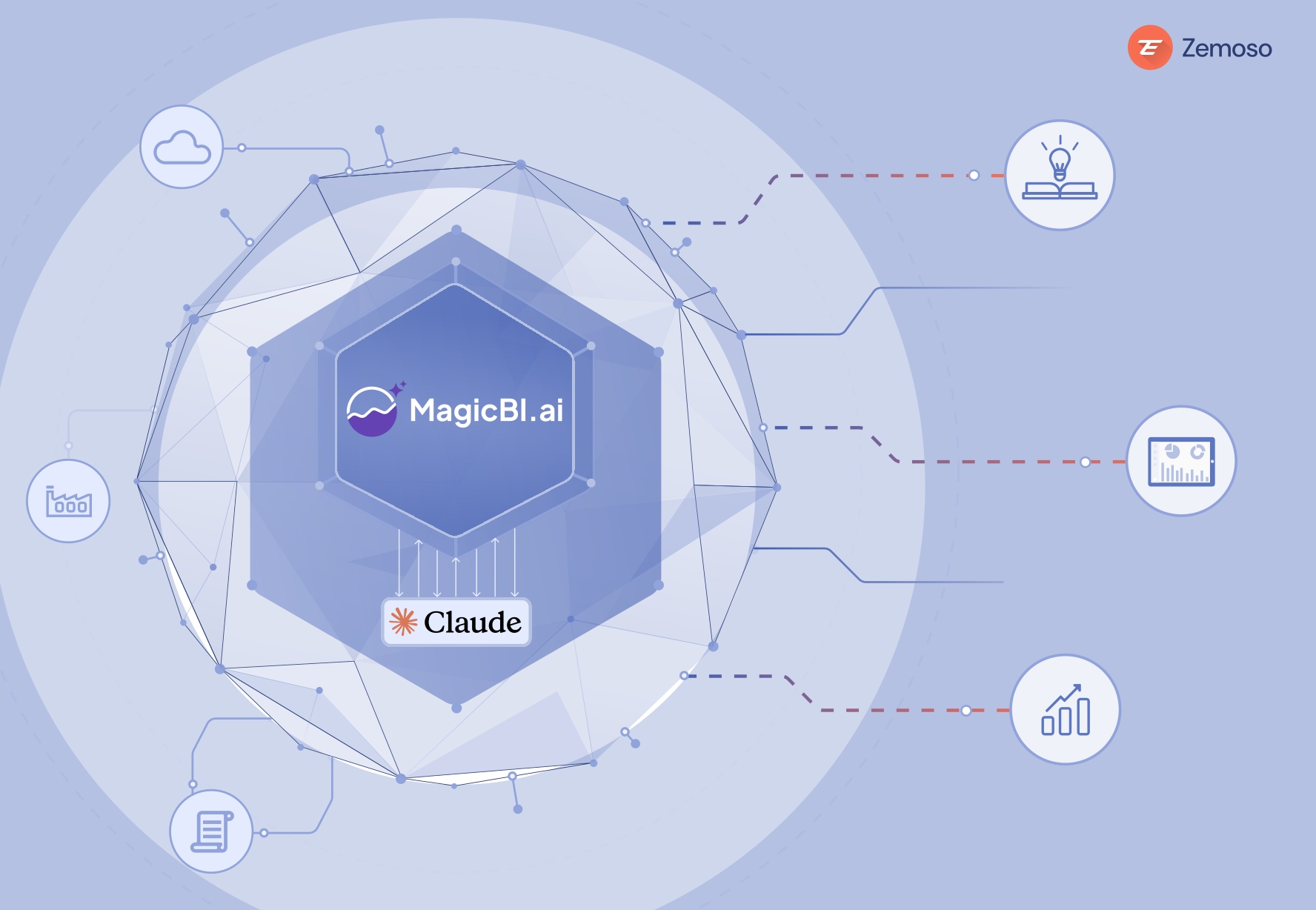
Beyond the development lifecycle, Claude models power several AI capabilities within MagicBI. Claude helps interpret natural-language business questions, reason over relevant business and data context, orchestrate analytical workflows, and transform analytical results into decision-ready experiences:
“MagicBI gave us an opportunity to apply Claude Code and MCP across a complex AI-native product lifecycle, going well beyond code generation. Together, we integrated Claude into product specification, development, design implementation, testing, and security workflows, helping the team move faster while maintaining the engineering rigor required for an enterprise analytics platform.” — Satish Madhira, CEO, Zemoso
MagicBI uses generative AI for reasoning, interpretation, and communication while keeping analytical computation deterministic. This separation allows Claude to help users explore, understand, and communicate analytical results without making the language model responsible for numerical correctness.
Integrating Claude Code and MCP into a continuous engineering pipeline yielded clear operational results across key engineering benchmarks:
* Impact figures are based on observed experience across selected workflows and are not independently audited benchmarks.
.svg)

Our clients love what we do:

Hardik Chheda, Founder & CEO
MagicBI
Shipping complex data systems requires an engineering workflow capable of matching the domain’s complexity. By combining Claude-powered development workflows with a disciplined architecture for AI-assisted analytics, MagicBI and Zemoso have accelerated product development while maintaining the standards required for enterprise analytics.
Claude is now embedded not only in how the team builds the product, but also in how users interact with it.
MagicBI is an AI-native autonomous analytics platform that gives business teams boardroom-ready answers, dashboards, and narratives directly from their data, without requiring SQL.
Proprietary algorithms, underlying source code, and specific enterprise client data remain protected in accordance with applicable non-disclosure and intellectual property agreements.