Thank you for wanting to learn more about us. Download the PDF
here.
To stay updated with our latest content, please follow us on LinkedIn.
Oops! Something went wrong while submitting the form.
Healthcare
Healthcare

AI-Powered Medical Coding for

Faster Revenue Cycles

Services Rendered

Product Design

Product Engineering

Rapid Prototyping

Tech stack

Angular, Python, FastAPI, Neo4J, OpenAI, Knowledge Graph, AWS, Amplify, AWS ECS , AWS RDS, AWS Load Balancer, Route 53, OAuth 2.0, AWS CloudWatch, Nagios, Grafana, Amazon SQS

Introduction

Revenue cycle leaders are under pressure: claim denials, staffing shortages in coding, and ever-changing regulations are tightening margins. Manual, coder-only workflows cannot keep up with volume variability and complexity. 

For Revenue Cycle Management (RCM) providers, manual medical coding has become a limiting factor. Coding delays slowed claim submission, reduced cash velocity, and constrained scalability.

To address this, a Dallas-based RCM company partnered with Zemoso to build AI Coder, an AI-powered medical coding platform designed to automate code assignment while maintaining compliance, accuracy, and human oversight.

iNDUSTRY CHALLENGE

Across healthcare, coding still runs on slow, manual work: coders read clinical notes and assign ICD-10 and CPT codes one by one, so backlogs build up and billing and reimbursement slip further behind. At the same time, hospitals are dealing with an estimated 30% shortage of medical coders, making it harder and more expensive to staff teams that can keep up with demand. 

Together, this creates a chain reaction: delayed or inaccurate coding leads to denied or slowed claims, revenue leakage, and cash-flow pressure, which in turn limits what hospitals can invest in staff, equipment, and services. Patients feel this as longer wait times, reduced access, and a poorer overall care experience.

Zemoso Labs Partnership Challenge

The client’s challenge was not simply automation. It was architectural credibility.

The organization needed to:

  • Reduce coding turnaround time without increasing denial rates
  • Absorb volume variability without hiring proportionally
  • Introduce AI without compromising audit defensibility
  • Demonstrate measurable accuracy improvement over time

This required building a system capable of learning, scaling, and integrating into existing billing workflows without disrupting client infrastructure.

Zemoso’s mandate was to engineer an AI solution that increased velocity while protecting compliance integrity.

Impact created

Within six months, the solution streamlined patient record processing and shortened claim cycles, directly improving hospital cash flow.

What are our clients saying?

Our clients love what we do:

How did we do this?

Heading 1

Heading 2

Heading 3

Heading 4

Heading 5
Heading 6

Lorem ipsum dolor sit amet, consectetur adipiscing elit, sed do eiusmod tempor incididunt ut labore et dolore magna aliqua. Ut enim ad minim veniam, quis nostrud exercitation ullamco laboris nisi ut aliquip ex ea commodo consequat. Duis aute irure dolor in reprehenderit in voluptate velit esse cillum dolore eu fugiat nulla pariatur.

Block quote

Ordered list

  1. Item 1
  2. Item 2
  3. Item 3

Unordered list

  • Item A
  • Item B
  • Item C
Text link

Bold text

Emphasis

Superscript

Subscript

Solution

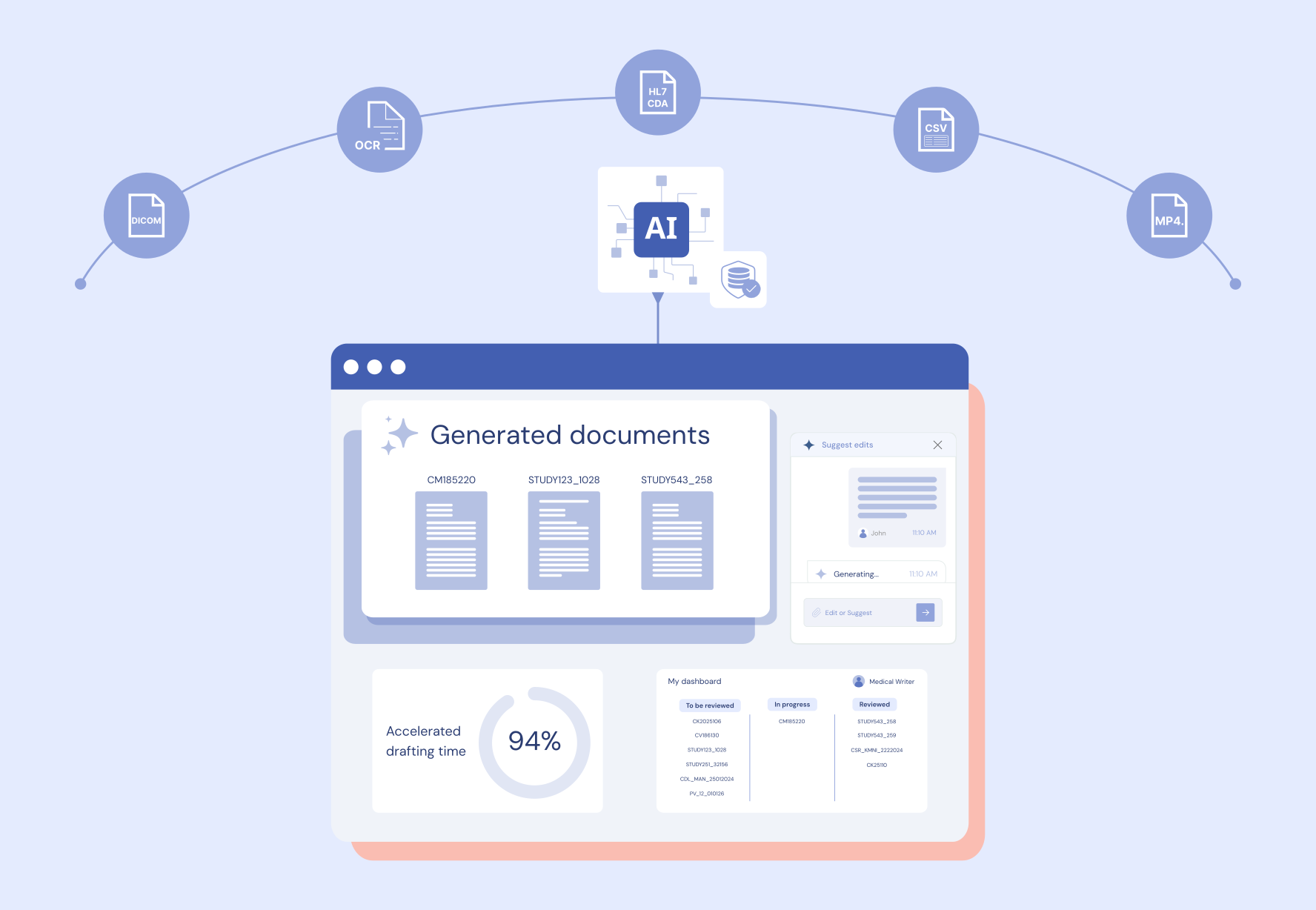
The AI medical platform automates coding with 95% accuracy while keeping coders in charge of final decisions.

Engineering highlights: 

  • Asynchronous coding pipeline: Clinical notes are ingested via queues and processed in parallel worker flows, so volume spikes don’t turn into coding backlogs.
  • Medical Knowledge Graph: A Neo4j-based medical Knowledge Graph encodes CPT/ICD codes, hierarchies, and relationships, giving the system a structured, clinically grounded foundation instead of relying on free-text alone.
  • Hybrid search + LLM intelligence: Deterministic graph traversal, BM25 text search, semantic vector search, and LLM-based reranking work together to turn unstructured notes into high-confidence CPT/ICD suggestions while minimizing hallucinations.
  • AI-assisted coder workspace: Coders start from ranked AI suggestions and refine them using search, modifiers, CPT-ICD linking, and drag-and-drop priority instead of coding from scratch.
  • RCM integration: Finalized codes flow back into existing billing and RCM systems through clean interfaces, shortening claim cycles without a rip-and-replace of the current stack.

Conclusion

The autonomous coding solution provided the RCM company with a scalable engine that increases coding velocity while maintaining compliance integrity. It replaces linear, labor-bound workflows with structured AI augmentation, positioning the company to compete in a revenue cycle environment increasingly defined by speed, accuracy, and defensible automation.

CASE STUDIES

We help you convert great ideas

Got an idea?

Together, we’ll build it into a great product

©2025 Zemoso Technologies. All rights reserved.