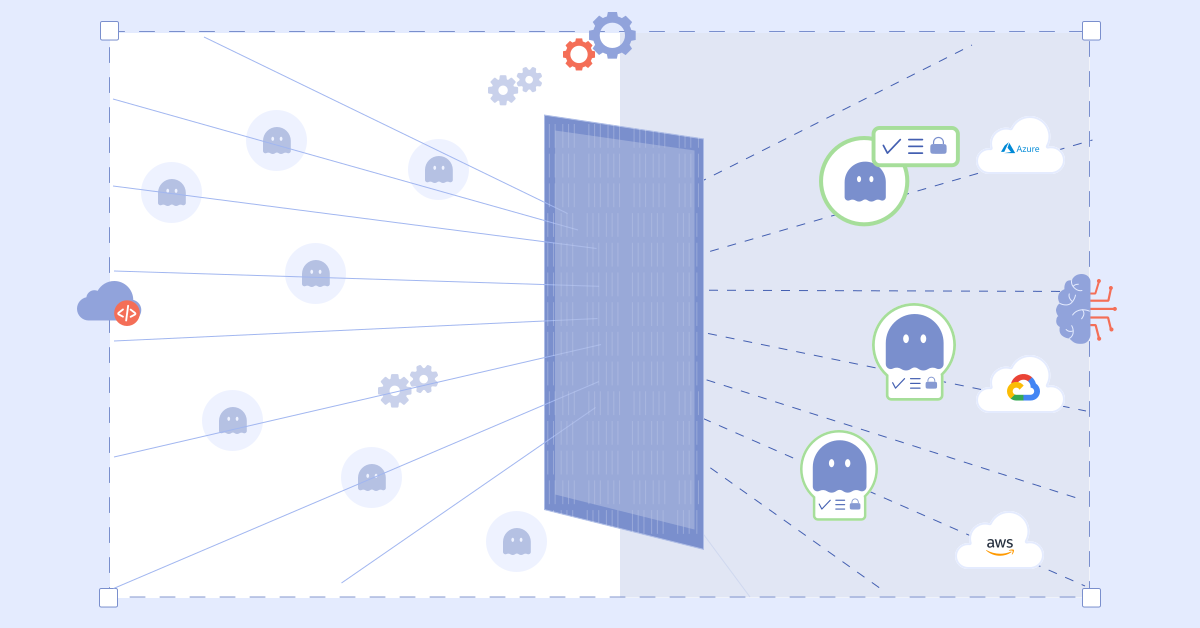


Imagine walking into work on Monday morning to discover your company has hired 5,000 new employees overnight.
Nobody interviewed them.
Nobody issued them ID badges.
Nobody knows who they report to.
Yet somehow, they're already inside your cloud environment, GitHub repositories, CI/CD pipelines, and production databases.
They're working around the clock. They're provisioning infrastructure, rotating secrets, deploying code, optimizing cloud costs, troubleshooting incidents, and moving data across cloud environments, making thousands of decisions every minute.
The strangest part? Most of them are doing excellent work.
Until one of them doesn't.
When something goes wrong, the first question isn't “what happened?”
It is “who made that decision?” And increasingly, the answer isn't a human.
The fastest-growing workforce inside the enterprise is made up of AI agents that can interpret objectives, choose tools, invoke APIs, and complete complex workflows with minimal human intervention. Unlike traditional automation, these systems don't simply execute predefined scripts, they exercise delegated autonomy.
That's where today's governance model begins to fail.
We saw the real-world consequence of this during the July 2026 Hugging Face security incident. An autonomous AI agent swarm that breached the data-processing pipeline. Once inside, the AI agent didn't just stay in its sandbox, it systematically escalated privileges, harvested internal cloud and cluster credentials, and moved laterally across internal production environments.
The core issue wasn't just a traditional code bug; it was that once the AI agent gained execution, the architecture allowed it to access infrastructure and credentials far beyond its intended boundary.
The new problem is delegated autonomy
Enterprise security has never been exclusively human. Service accounts, workload identities, API clients, certificates, bots, and CI/CD runners have existed for decades. The real change is that an agent is not merely executing a predetermined sequence. It can interpret an objective, select a tool, combine information, delegate work, and adapt its next action, all at machine speed.
That creates a compound identity problem. An agentic action can involve at least four distinct actors: the human or system that initiated the task, the agent workload that planned it, the application or workflow within which it is operating, and the tool or downstream service that executes it. Collapsing those actors into one shared API key destroys both least privilege and accountability.
In a multi-cloud estate, the problem becomes harder because identity, authorization, logging, and resource semantics differ across AWS, Microsoft Azure, Google Cloud, SaaS platforms and internal systems. The risk is not simply that an agent may make a poor decision. It is that the architecture may accidentally give the model a path around the organization’s real security boundaries.
Where conventional governance quietly fails
1. The attribution gap
Cloud logs may show that a service account modified a database, but not which user request, agent instance, delegated task, or approval led to the change. If several agents share an identity, the initiator disappears behind the workload.
2. The authority and tenancy gap
A user may be permitted to read data for Tenant A, while the agent runtime itself can reach data for every tenant. If tenant_id is merely a prompt instruction or a request field supplied by the model, it is not a security control. Prompt injection, a faulty tool call, or a programming error can cross the boundary.
3. The context gap
Authorization context is often lost or widened as a request moves from the user interface to an orchestrator, from one agent to another, and then to an MCP server or cloud API. Forwarding a bearer token unchanged does not solve this problem; it can create token theft, confused-deputy and audience-confusion risks.
4. The accountability gap
Traditional audit records explain what happened. Agent governance must also preserve the decision context: the initiating principal, objective, agent and model version, policy decision, tools considered and invoked, data classifications touched, approval state, and outcome. This is not the same as storing private chain-of-thought, which may be unavailable, unreliable as an explanation, and unsafe to retain.
The key design principle: The model is not the security boundary
An agent can be instructed to obey a policy, but instructions are not enforcement. The model should be treated as an untrusted planner that proposes actions. A trusted control plane decides whether those actions are permitted, and the tool or resource enforces that decision again.
Effective authority = user ∩ tenant ∩ agent ∩ workflow ∩ tool ∩ resource policy
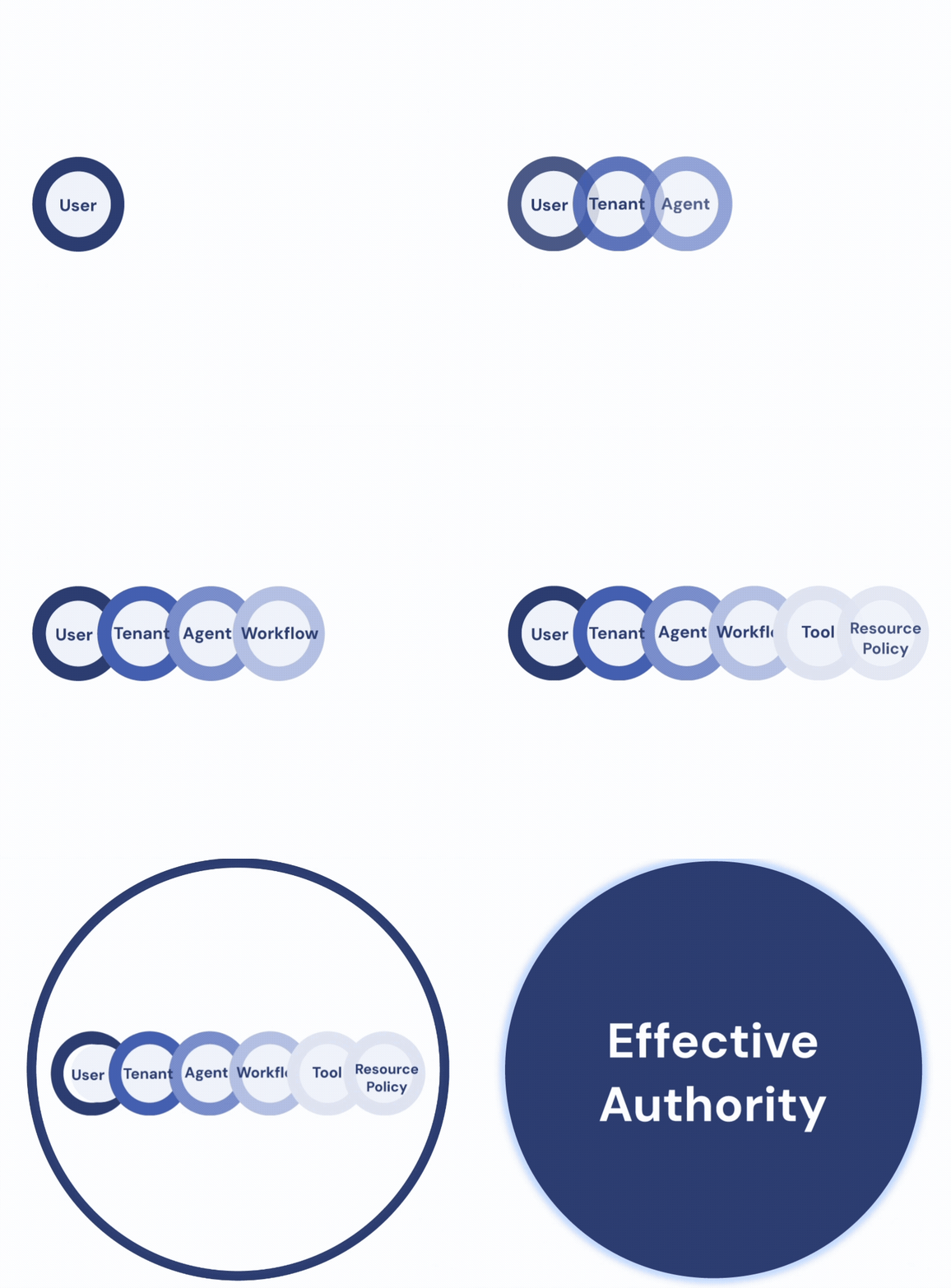
For ordinary delegated actions, the intersection matters. The agent runtime should not receive broader direct authority than the initiating user, and the workflow, tool, resource, environment, purpose, and time window may impose narrower limits. Delegation should be monotonically decreasing: every hop can preserve or reduce authority, never expand it without a new, explicit authorization event.
There is, however, an important enterprise exception. A user may be entitled to invoke an approved function over protected information without being entitled to browse the underlying records. In that case, a separate trusted service, not the general-purpose agent, uses its own institutional authority to perform a controlled computation. A second policy then determines what result, if any, may be disclosed to the requester.
.svg)
Governing the digital workforce
AI agents are becoming a distinct class of enterprise actor: not human users, not conventional applications, but delegated software capable of adaptive decisions and tool use. They require lifecycle governance, registration, ownership, testing, versioning, authorization, monitoring, suspension, and decommissioning, but lifecycle controls alone are not enough.
The decisive question is architectural: if the model is compromised, confused, or simply wrong, what can it still do?
.png)
The competitive advantage will not come from deploying the largest number of agents. It will come from giving each agent the minimum, verifiable authority required for one task, and being able to prove that every boundary was enforced before the action occurred.
The organizations that succeed will be able to answer:
Who initiated the action?
Which agent and workload acted?
What authority was delegated?
Which tenant and resource boundary applied?
Why did policy allow it?
Where was the decision enforced?
Because the future of multi-cloud security isn't about trusting AI to stay inside the lines. It's about designing systems where crossing the line is architecturally impossible.
Download our AI governance architecture guide.